

I have written several day-in-the-life stories over the years. Now, AI and agents are drastically changing what corporate recruiting looks like, so here is an updated version. Not much of what a day used to look like remains, except people interacting with people.
By 2030, the talent leader no longer runs the recruiting function in the traditional sense. There are relatively few recruiters, few requisitions moving manually through an ATS, and little time spent sourcing, screening, scheduling, writing job descriptions, coordinating interviews, or generating reports. Thankfully, agents now do most of that.
The talent leader has become more of a capability architect, talent strategist, organizational intelligence analyst, and executive advisor. The terms aren't well established yet, but the ideas are clear.
Instead of asking how we fill this job or where we'll find the right person, we now have a far more strategic question to answer: What combination of people, skills, technology, automation, and organizational redesign will produce the outcome the business needs?
That is a very different question and requires people with a different set of skills. AI hasn't taken our job; it’s reinvented it and turned it into a new profession.
7:15 AM — The Talent Intelligence Briefing
The talent leader most likely begins the day by chatting with an AI talent intelligence agent. No dashboard to open and very little data to hunt for. The agent is constantly examining internal workforce data, business forecasts, productivity data, labor-market information, demographic changes, compensation trends, employee skills, attrition patterns, competitor hiring, immigration changes, university output, and the organization’s portfolio of AI agents. It synthesizes large amounts of information and data, looks for patterns, and delivers summarized, verified insights to leadership.
In this case, it identifies four developments requiring human attention.
· Engineering demand in Southeast Asia is rising faster than expected.
· The company’s European workforce is aging significantly faster than its North American workforce.
· AI automation has reduced the projected requirement for entry-level finance employees by 38%.
· And a competitor has begun hiring aggressively for a skill the company’s product strategy suggests it will need within eighteen months.
The AI doesn't just report these facts. It also models alternatives and presents what-if scenarios for discussion.
“If current trends continue, the organization will have an estimated 430-person capability gap in applied AI engineering by Q3 2032. There are five plausible interventions.”
The talent leader’s job is not to produce the analysis. It is to ask the agent questions such as:
· What assumptions produced the 430-person estimate?
· How sensitive is it to product growth?
· Which skills are actually scarce?
· Could existing employees acquire them?
· Could some work be automated?
· Could contractors or partners provide the capability?
· Could the work itself be redesigned?
The competency is no longer conventional data analysis. AI does most of the analysis. The human competency is data interpretation, skepticism, hypothesis formation, and judgment under uncertainty.
8:30 AM — Meeting With the Business
The CFO wants approval to hire 140 people. And sets up a meeting with the talent leader. Ten years earlier, talent acquisition would have taken his order and opened 140 requisitions, likely with few, if any, questions or pushback, but that doesn't happen now.
Instead, the talent leader arrives with an AI-generated workforce simulation. The analysis suggests that the reqs the CFO wants approved represent only approximately 92 conventional full-time-equivalent jobs. But even that number is misleading.
He points out that AI agents could perform roughly 35% of the activities. Twenty-three employees elsewhere in the company already possess adjacent skills and could potentially move into the function. An RPO could handle a temporary peak in implementation. Only about 45 permanent hires appear necessary.
The conversation therefore isn’t about how quickly recruiting can fill 140 jobs, but about why we need 140 people. Talent leaders become challengers of labor demand, not processors of it.
To fill this role, they will need enough knowledge of finance, operations, organizational design, technology, and strategy to challenge senior executives intelligently. Their value comes partly from preventing unnecessary hiring.
10:00 AM — The Human Exceptions Meeting
Millions of routine talent decisions are being made or recommended by agents. Most require no intervention and are routine.
The talent team concentrates on exceptions. For example, an assessment agent has identified an unconventional candidate whose experience doesn't match the normal career pattern but whose underlying capabilities are unusually strong.
Several automated systems have rejected another candidate despite strong performance indicators. An internal employee has been recommended for a role three organizational levels above her current position. A hiring agent and an internal mobility agent disagree about whether to fill a position externally.
These are judgment problems. The humans investigate the evidence, question the models, examine unusual signals, and occasionally override the machines.
The paradox of recruiting in 2030 is that humans may make far fewer decisions, but the decisions they make are more consequential.
11:30 AM — Talent Scenario Planning
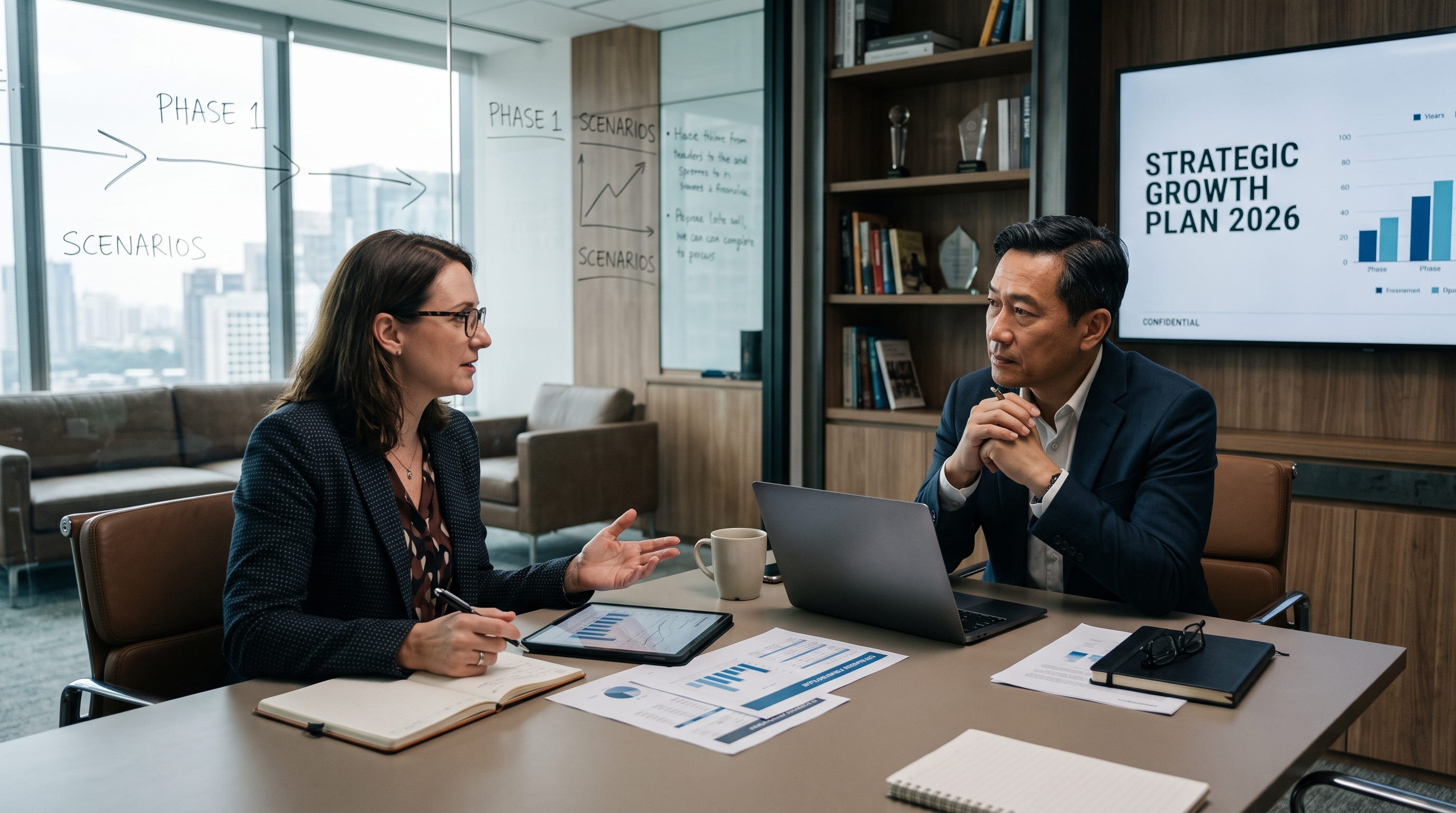
The company is considering entering two new markets in 2032. They asked the talent leader to provide a workforce scenario. The TA leader provides them with several for discussion.
Become a paid member to receive additional posts on the future of TA and HR, plus access to our new feature exclusively for paid subscribers: The Future of Talent Intelligence Brief, which provides monthly intelligence on what is changing, which trends matter, what is hype, new technologies, and what TA leaders should do about it, as well as my predictions.
One scenario assumes aggressive automation. Another assumes slower AI adoption but greater use of external talent. A third assumes acquisitions will provide scarce capabilities. And a fourth relies heavily on reskilling existing employees. Each scenario includes estimates of cost, skills availability, demographic risk, regulatory exposure, time to capability, and organizational resilience.
The talent leader’s role is no longer workforce planning as we once understood it, but workforce scenario design. Having foresight has become a needed competency.
The organization is asking:
· What might happen?
· What would have to be true for it to happen?
· What signals would tell us that it is happening?
· What options should we preserve today so that we can respond tomorrow?
1:00 PM — No Recruiting Meeting
There is no weekly requisition meeting. There are no discussions about time-to-fill. Nobody asks how many candidates were sourced last week. Those activities have become machine operations.
Instead, the talent organization meets to review the company’s Talent Risk Map.
They discuss five questions:
· Where are we becoming dangerously dependent on scarce skills?
· Where could automation eliminate significant amounts of work?
· Which critical capabilities are concentrated in too few individuals?
· Where is demographic change likely to create shortages?
· Where are we losing knowledge faster than we are replacing it?
Talent has begun borrowing concepts from supply-chain management. Skills have supply, demand, lead times, substitution possibilities, geographic constraints, and concentration risks. The talent leader manages these risks much as a supply-chain executive manages critical materials.
2:00 PM — Designing Work Rather Than Jobs
A business unit needs more customer-support capacity. The old solution would have been to hire customer-service representatives. Instead, the talent leader participates in a work design session.
This involves partnering with the AT agent to break the work into several hundred activities. Some should be fully automated. Some should be performed by AI with human supervision. Some require empathy, negotiation, or judgment. Some can be moved to existing employees. And some can be handled by specialists working only a few hours per week.
Only after redesigning the work does the organization decide whether to hire anyone.
This requires talent professionals to understand task decomposition, workflow design, human-machine collaboration, and organizational systems. The unit of analysis is no longer the job. It is the task, capability and outcome.
3:30 PM — Candidate and Employee Advocacy
Automation has made recruiting extremely efficient, but it has also created new problems. Candidates are interacting with the employer’s agents while using their own AI agents. Candidate agents negotiate with employer agents and compare compensation. They submit credentials, schedule interviews, and research organizational culture. Some of these agents may even conduct first-level negotiations.
The talent leader therefore determines where human interaction actually matters. Senior candidates still expect access to senior leaders. Employees facing major career transitions want human conversations. Candidates rejected after substantial investment expect explanations.
The talent function deliberately identifies moments when human attention builds trust, recognizing that efficiency is no longer the objective. Human attention is a scarce resource that must be allocated deliberately.
4:30 PM — Advising the CEO
The CEO wants to know if the firm will have the talent to execute its planned strategy in the next three years. The talent leader cannot answer with headcount projections as skills are fungible, and strategies change rapidly. Rigid planning rarely stands up to time.
Instead, she explains that they have identified three capabilities that represent significant risks.
One can probably be developed internally, and another can likely be automated. However, the third is becoming globally scarce and should probably be acquired now.
With the help of the AI agent, she can present alternative scenarios rather than a single forecast and use her judgment to guide this conversation, based on data she can share with the CEO.
These are skills and directions that define our new profession.