

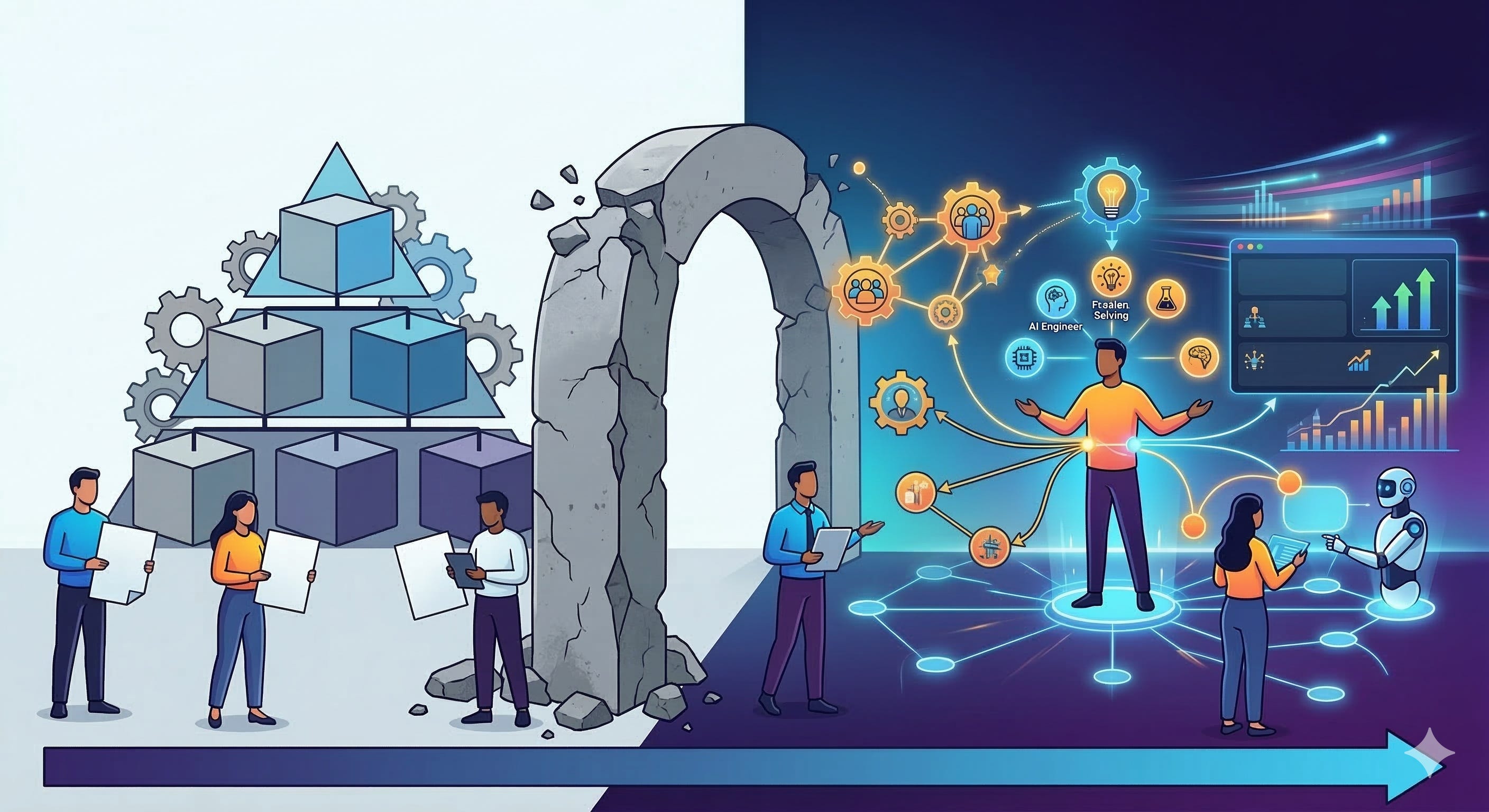
Note: This is a longer article than usual because it discusses where work is heading and how what has happened in the AI job marketplace foretells what is coming for all of us.
For more than a century, the job description has been the foundational unit of work organization. It was a model built on the assumption that work is stable enough to be described in advance. That work consisted of a set of duties, reporting relationships, qualifications, and expected outputs that remained consistent over time, and that this set of duties equaled what we call a “job.” That assumption is crumbling.
And if you want to see where it crumbles fastest, watch what is happening to the AI labor market right now.
Consider the title “AI Engineer.” It did not exist as a recognized role category five years ago. Today, it commands a median total compensation exceeding $245,000 in the United States, with top earners at frontier companies pulling $875,000 or more.
Netflix posted a single AI role with a salary ceiling of $900,000. Anthropic and OpenAI have structured packages for senior researchers that reach eight figures over multi-year terms. These are not anomalies in an otherwise stable compensation landscape. They are the leading edge of a structural rupture.
What makes the AI labor market instructive is not the numbers themselves but the logic behind them. Companies are not paying $800,000 for a job. They are paying for a specific, rare, time-sensitive capability to build and deploy systems that will reshape their entire cost structure. The capability is everything. And that same logic, once loosed from the frontier of AI, will migrate steadily into the rest of the economy.
A Tale of Two Labor Markets
The AI employment market has already split the world of work into two sharply diverging tracks. In 2025, tech companies laid off nearly 131,000 workers while simultaneously struggling to fill AI and machine learning positions. Microsoft eliminated thousands of jobs and raised AI engineer salaries past $300,000. Amazon cut positions across multiple business units and, within weeks, posted hundreds of openings for data scientists and ML specialists.
Human resources departments whose entire function is organized around job descriptions saw job postings decline by 16% as the sector was itself restructured. AI-related HR postings, by contrast, surged 25% in the first quarter of 2025 alone, with median salaries hitting $157,000.
This is not a contradiction. It is a preview. Companies are eliminating roles defined by stable, specifiable task sets that can be written into a job description, while hiring capabilities that are fluid, rare, and compounding in value. The job description, as a technology, was built for the first category of work. It has almost nothing useful to say about the second.
Younger workers are learning this lesson the hard way. Entry-level positions have declined 29% since January 2024. The unemployment rate for college graduates aged 22–27 reached 4.8% in mid-2025, meaningfully above the overall rate, as the traditional entry-level-to-executive career ladder built entirely on the logic of job-based progression fractured under the weight of AI-driven task automation. A degree in hand and a job description to match no longer adds up to a career path.
From Roles to Tasks, Skills, and Projects