
Get Ready to Count Your Robots
When a robot does the work of a person, does the robot count as part of your workforce?

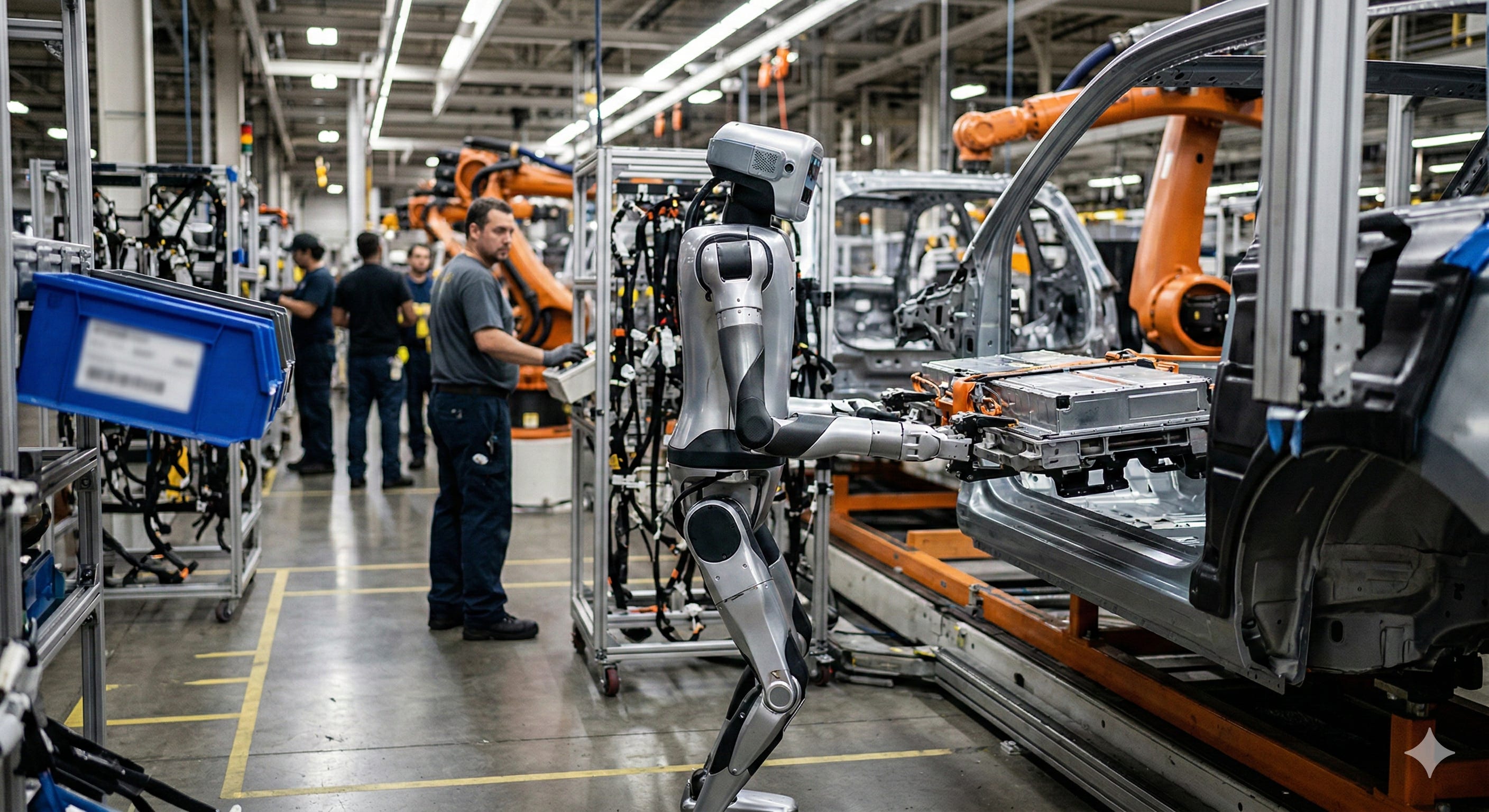
When I first wrote about humanoid robots and recruiting in mid-2025, the honest answer was that the technology was impressive but mostly just staged. The deployments were only pilots, heavily supervised, limited to structured environments.
Nine months later, everything has changed.
The robots are working. Not in demos. Not in controlled labs. In actual production facilities, alongside actual human employees, doing actual jobs. And that shift forces a question that the talent management profession has not yet seriously grappled with:
When a robot does the work of a person, does the robot count as part of your workforce?
What Has Changed Since Last Year
The pace of deployment has accelerated beyond most forecasts. A few data points:
Amazon now operates one million robots across its fulfillment network. That number is close to the global human headcount of roughly 1.6 million. Three-quarters of its global deliveries are now aided by robotics. Meanwhile, it has cut 30,000 corporate roles since October 2025. The robot count goes up; the human count comes down.
Toyota Motor Manufacturing Canada signed a Robots-as-a-Service agreement with Agility Robotics in February 2026 to deploy Digit humanoid robots for logistics and supply chain work at its Woodstock facility. This is not a test. This factory plant has about 8,500 human employeed but I wonder how many will be there in a year? Agility’s Digit is the world’s first commercially deployed humanoid, with paying customers now including GXO Logistics, Schaeffler, Amazon, and Mercado Libre.
Mercedes-Benz has partnered with Apptronik and has been using robots in manufacturing facilities since late 2025 and early 2026. Delivering assembly kits to the production line and inspecting components.
Goldman Sachs and Bank of America project 50,000 to 100,000 humanoid units deployed globally by the end of 2026. That number could hit the millions by 2030. The market value of industrial robot installations already reached an all-time high of $16.7 billion as of January 2026, according to the International Federation of Robotics.
The business model is shifting.
Robots-as-a-Service allows firms to use robots as a subscription rather than classify them as a capital purchase. This is becoming the dominant model. This makes robots accessible to companies that cannot afford to buy them outright. It also makes the headcount accounting question more complicated. If you are “leasing” a robot the way you lease a vehicle, is it your employee, your equipment, or your vendor’s asset? An HR and legal paradox.
The Headcount Question Nobody Is Asking
Here is where talent management professionals need to wake up.
Current legal definitions of “employee” are entirely built around humans. There is no provision in the Fair Labor Standards Act, the WARN Act, or the EEOC reporting requirements for a robot. These frameworks assume that a “worker” is a biological person who can be hired, fired, discriminated against, and paid.
But those frameworks were also built for a world in which robots could not do most human jobs. That world is ending.
Consider what is already happening at scale. A company replaces 200 warehouse workers with humanoid robots. Under the federal WARN Act, if 500 or more employees lose their jobs at a single site, the company must give 60 days’ notice. Some companies have found a workaround: do not lay people off in a single wave. Reduce attrition. Let robots absorb the work as humans retire or quit. No mass layoff. No WARN notice. No severance. No headlines. The headcount on paper barely moves because the robots are not counted at all.
Should a Firm Count Robots as Employees?
Let’s ask the question directly, because no one else is.
If your company has 1,000 people on payroll and 250 humanoid robots doing the equivalent of 250 full-time jobs, what is your workforce size? Is it 1,000? 1,250? Or is it 1,000 humans and 250 machines, a distinction that matters enormously for how you recruit, plan, report, and compete?
There are serious arguments on both sides.
The case against counting robots as employees is straightforward. They are property, not people. They have no rights, no wages, no identity. Counting them as “staff” mixes a capital asset with a human being, which distorts every workforce metric from productivity to engagement to diversity.
But the case for some form of robot accounting is equally compelling. When a robot is doing the work of a person, including the same tasks, same hours, same output, and you exclude that robot from your workforce reporting, you are presenting a misleading picture. To investors, to regulators, to job candidates, to your own managers doing workforce planning.
Imagine two companies. Company A has 1,000 human employees and a productivity index of 100. Company B has 700 human employees and 300 humanoid robots doing equivalent work, but reports only 700 employees and shows a productivity index of 143. On paper, Company B looks dramatically more efficient. In reality, both companies have the same operational capacity. The difference is accounting, not performance.
This is not a minor disclosure question. It is a fundamental question of integrity about how organizations represent themselves.
What Legislation Is Starting to Say
Lawmakers are beginning to sense the problem, even if they are not yet solving it.
The AI-Related Job Impacts Clarity Act, introduced in the U.S. Senate in November 2025 by Senators Hawley and Warner, would require publicly traded companies to file quarterly reports to the Department of Labor detailing how many workers were laid off because their roles were replaced by AI, how many positions went unfilled due to automation, and how many employees were retrained. This is workforce accounting for the AI era, but it still focuses on human employees and their displacement — not on the robots themselves.
The U.S Senate is considering a law called The No Robot Bosses Act of 2025, which takes a different angle, requiring employers to audit AI tools for bias, maintain human oversight of AI-driven employment decisions, and disclose to workers when AI is being used to manage or evaluate them. But this is a long way from passing.
Neither bill requires companies to disclose how many robots they are operating, or to count those robots in any workforce metric.
The EU AI Act, effective in 2025, and the EU Machinery Regulation, effective in 2027, are beginning to establish certification pathways. But these are safety and liability frameworks. They do not address workforce representation.
What This Means for Recruiters and Talent Leaders
If you are in talent acquisition, this is not someone else’s problem.
Your job descriptions will need to specify whether a role involves working alongside humanoid robots and what that means for the human in that role. Your workforce planning models need to account for robot capacity, not just headcount. Your diversity reporting needs to clarify whether it covers your entire operational workforce or only your human employees. And your employer brand is going to face a new question from candidates: “How many of your employees are actually humans?”
That last question is not as absurd as it sounds. We already have candidates who ask about AI usage in hiring processes, remote work ratios, and team composition. The human-versus-robotic composition of the workforce is the next frontier for disclosure.
Some companies will get ahead of this. They will develop a framework that accounts for human employees, AI agents, and physical robots as distinct but related capacity inputs. They will use full-time equivalent (FTE) metrics for robots, measured in hours and output, while clearly separating them from human headcount for benefits, legal, and reporting purposes.
But most companies will not do this. Most will continue to report only human headcount, use robot deployment to quietly reduce human hiring, and treat the distinction as an accounting detail rather than a transparency obligation.
I predict that the gap between companies that are honest about their hybrid workforce and those that are not will be one of the defining talent market dynamics of the next five years.
The Bottom Line
Humanoid robots are no longer a thought experiment for workforce planners. They are deployed assets doing real jobs at Toyota, Amazon, BMW, Mercedes-Benz, GXO, and a growing list of others.
Our job now is to build the frameworks that reflect this reality honestly. That means creating new categories of workforce reporting, developing robot-inclusive capacity planning, and having transparent conversations with candidates, employees, and regulators about what our workforce actually means.
A firm that has 1,000 employees and 250 robots doing human-equivalent work is not a 1,000-person company.
What it is, exactly, is a question we need to start answering. Now.
I’m new to AIs , do need to learn how to use them better for better Galaxy .