

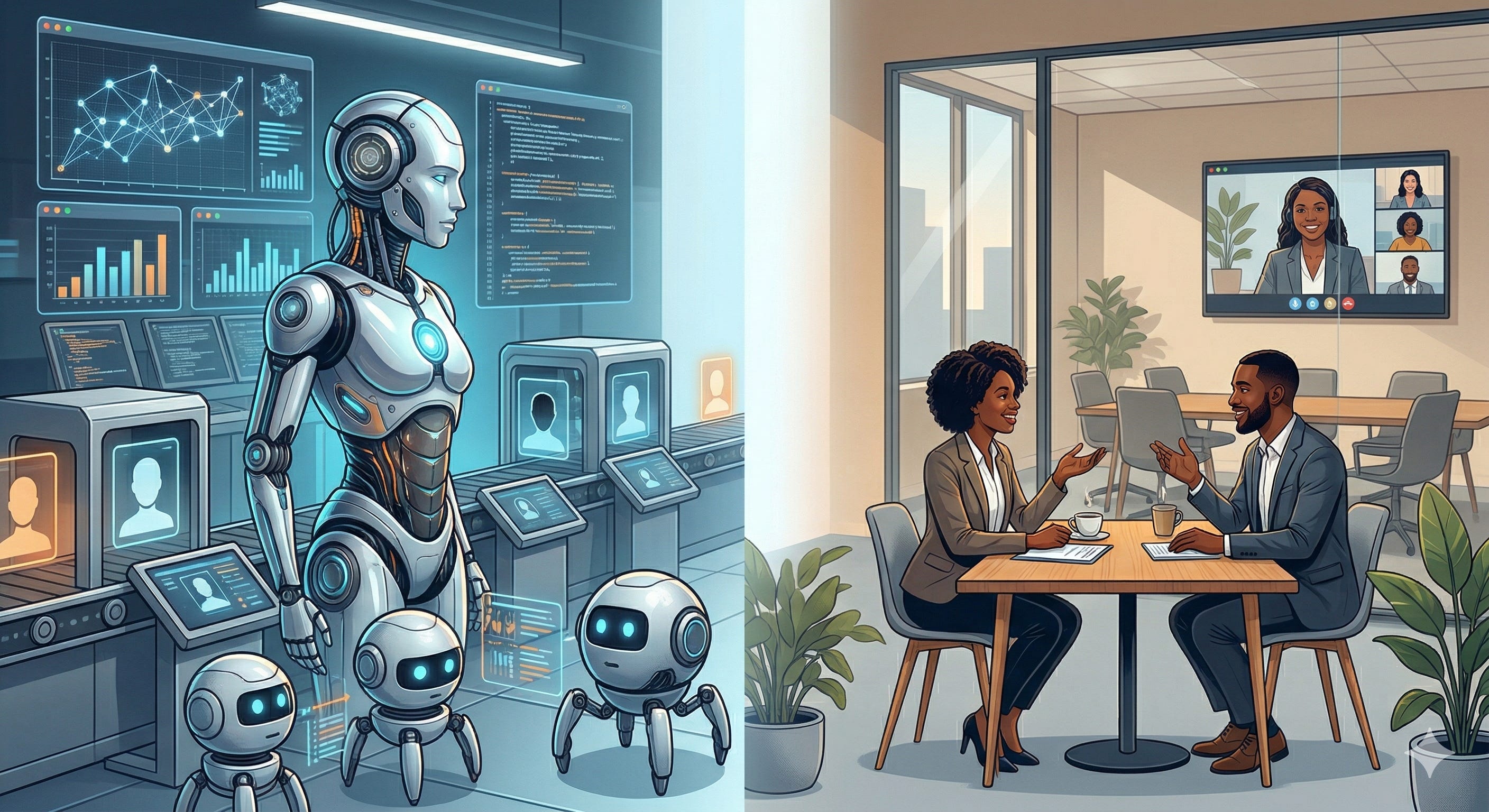
As I said in last week’s article, we are standing in the wreckage of the recruiting process. Artificial intelligence has increased the efficiency, scale, and speed of hiring processes, yet it has also led to the loss of meaningful human connection and increased candidate dissatisfaction.
The question is not whether to use AI in recruiting. That question has been answered.
The more important question is how to design a recruiting model in which AI handles scale and process optimization, while human interaction is available and used where it creates the greatest value.
This is the foundation of a high-touch, AI-enabled candidate experience.
The Core Problem: Efficiency Without Connection
No global recruiting function can operate efficiently without A)-based systems to increase speed and throughput. But these systems cannot make the process human. They cannot identify or reveal a candidate’s judgment, intent, adaptability, or cultural alignment.
As I said last week, at its core, recruiting is an information problem, but not all information can be quantified or measured. are often revealed only through human interaction. When we use AI, these interactions are minimized or eliminated, and recruiters and hiring managers risk making decisions based on incomplete or distorted data.
A New Design Principle: Human Interaction as a Strategic Resource
The solution is not to go back to fully manual processes. That would be both impractical and inefficient.
Instead, organizations must treat human interaction as a scarce and valuable resource, deploying it intentionally where it really counts in the candidate journey.
This requires a shift from a process-centric model to an experience architecture model. Rather than asking, “Where can we automate?” the more relevant question becomes, “Where does human interaction create the greatest value?”
There are three critical moments or times in a candidate’s journey that are critical:
Moments of uncertainty – where candidates need clarification, reassurance, or context
Moments of evaluation – where nuanced judgment is required from both sides
Moments of decision – where commitment, negotiation, and alignment occur
We need to design a high-touch experience at each of these points.
Practical Strategy 1: Humanize the First Meaningful Interaction
AI is highly effective at initial sourcing and outreach, but the transition from automated engagement to human contact is often poorly designed. Many candidates interact with bots or automated emails for extended periods before speaking with a recruiter.
This is a missed opportunity.
The first meaningful human interaction should occur early enough to establish credibility and trust, but not so early that it disrupts scale. A practical approach is to:
Use AI for initial identification and qualification
Trigger a human interaction once a candidate meets predefined relevance thresholds
Ensure that the first human conversation is meaningful, not transactional
This interaction should focus on understanding the candidate’s motivations, constraints, and career context, rather than simply validating resume data. It sets the tone for the entire experience.
Practical Strategy 2: Redesign Screening as a Hybrid Process