

The corporation has been, and remains, the core around which every city, every government, and most jobs are built. It is the principal employer, and for those not directly employed by the corporation, it supports a secondary economy of restaurants, realtors, suppliers, and delivery services, to name just a few. The taxes it pays fund city governments, public schools, and the infrastructure we all depend on. The deductions (taxes) taken from workers’ wages fund medical, retirement, and social services.
But this model is under pressure and is slowly unraveling. To understand why we need to understand why large corporations exist in the first place. In classical economic theory, firms exist because using the open market is expensive. Finding specialized individuals, verifying competence, negotiating terms, and monitoring performance all carry transaction costs. When costs are high, bringing work inside and directing it via payroll and managers is cheaper than contracting piece by piece. It was necessary for manufacturers to have large numbers of workers to make, assemble, and distribute their products.
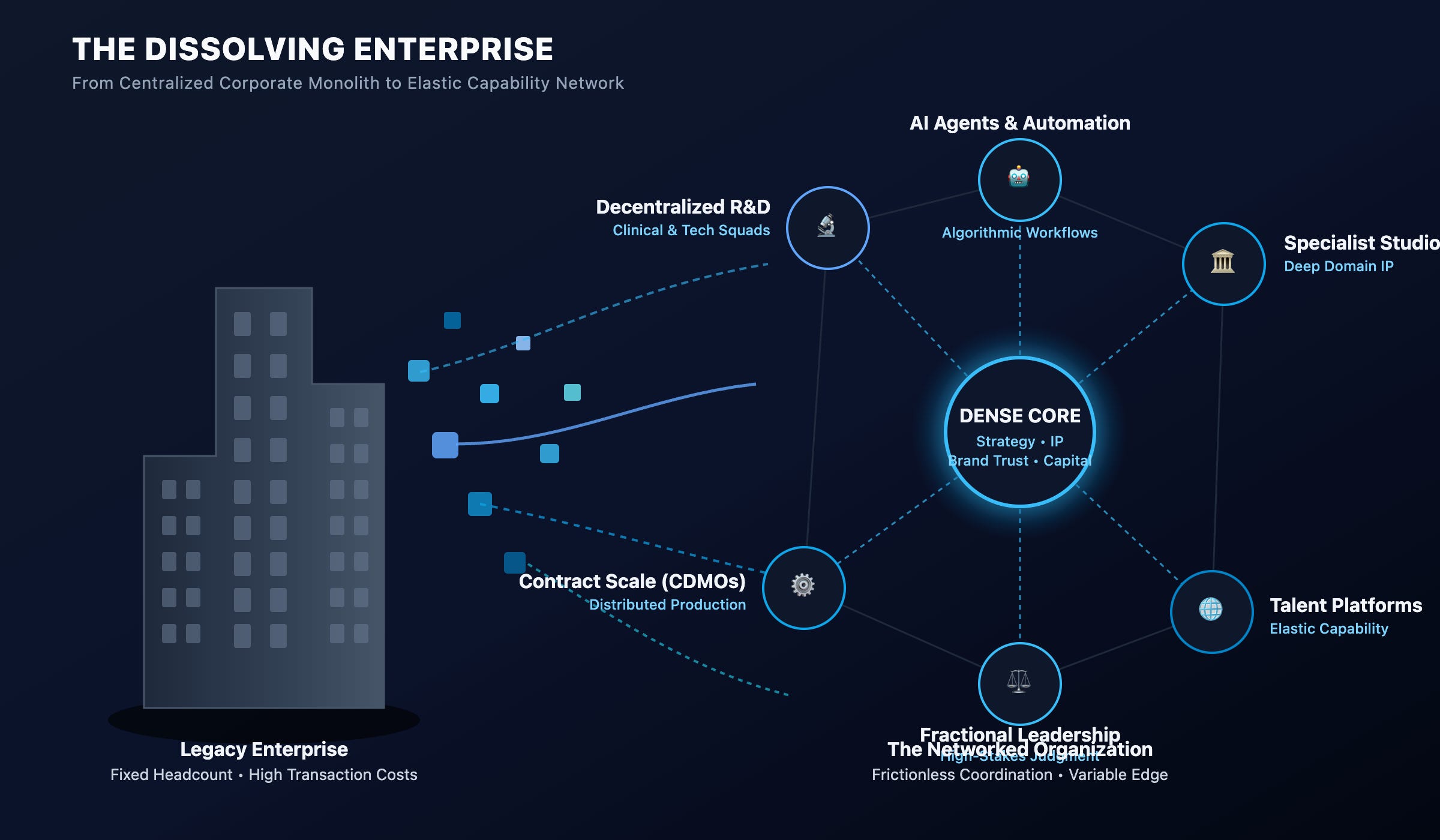
However, the evolving capabilities of AI, along with the near-universal availability of Wi-Fi, advanced robotics, and the growth of complex global networks, make communication, task matching, coordination, manufacturing, and verification nearly frictionless. The economic boundary of the enterprise is dissolving.
The Architecture of the Thin Firm
The corporation has been slowly reorganizing into a model defined by a small, high-judgment core of people surrounded by a flexible network. This means that maintaining large pools of permanent headcount, primarily for administrative or coordination work, is now a liability.
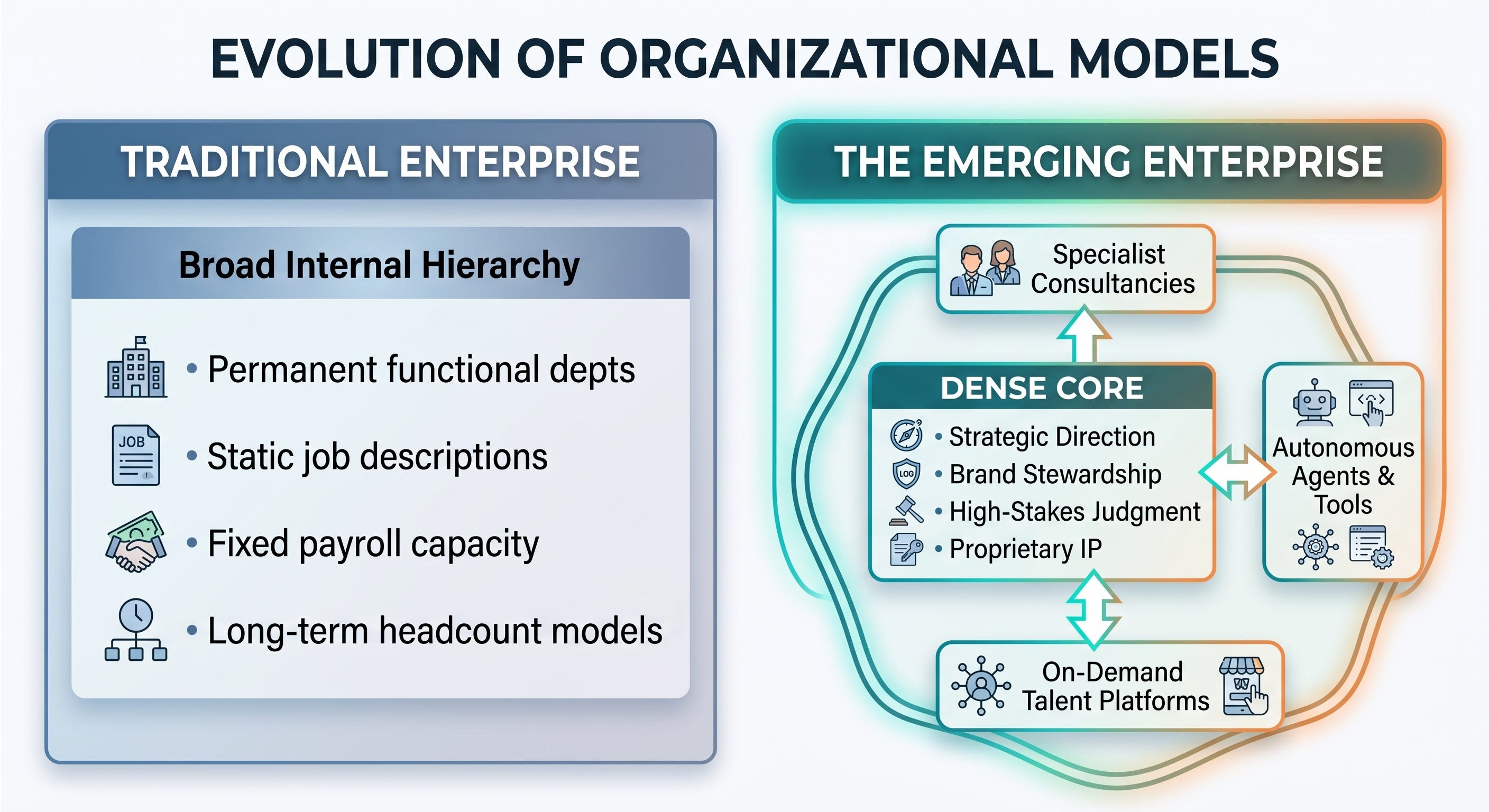
This core keeps only what cannot be safely outsourced or automated: strategic vision, institutional trust, brand ownership, proprietary intellectual property, and high-consequence judgment calls. Everything else eventually migrates into an ecosystem of part-time specialists, independent consultants, digital platforms, robots, and autonomous workflows.
What Is the New Model?
The fading traditional corporation is being replaced by several different dynamic, disaggregated operating models:
