

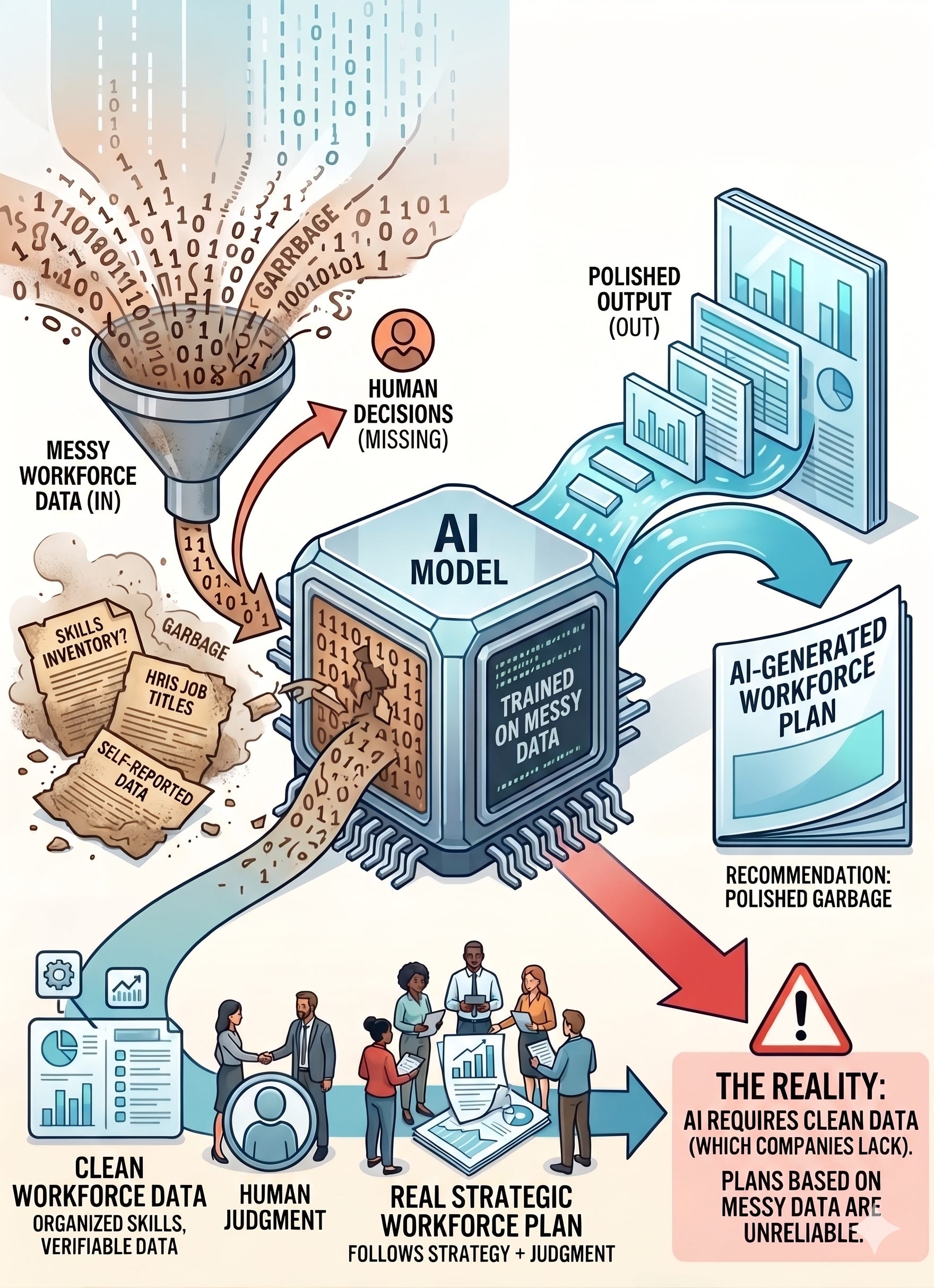
Talent intelligence is the current rave. Several vendors are working on or already offering talent planning data. Their offer is seductive. They promise that if you feed AI the org chart, financial info, a skills inventory, if you have one, and some market data, you will get a workforce plan. That plan will include a recommendation for how many people you need, with what skills, in which locations, at what cost, eighteen months from now.
The vendors offering this break into three camps. Workday leads on connected, scenario-driven financial planning; Oracle and SAP offer suite-native depth; Visier, Eightfold, Gloat, and Reejig cover skills intelligence, analytics, and mobility. Add Draup and the former Skyhive for job-to-automation estimation. But how good are the results? And can Ai really do this now?
Not close, yet, and maybe never.
The First Problem is the Data
Workforce planning runs on data. Bad data produces bad plans, and most companies have bad data. I have not encountered one firm with good, verifiable data about its workforce or its skills.
Start with the skills inventory. Almost no organization knows what skills its people have. The HRIS has job titles and pay grades, but it does not record the quiet data. It doesn’t know that the financial analyst taught herself Python last year or that the warehouse supervisor ran a logistics operation in the military. Skills data is self-reported, out of date, or absent. The taxonomies are not consistent. One system calls it “project management,” another “team leadership,” and a third does not capture it at all.
AI does not fix this. AI just inherits whatever data there is, whether good or bad. And, a model trained on garbage produces polished garbage.
The talent intelligence everyone wants requires a clean, current, structured view of the workforce that very few companies possess. Until that exists, AI makes assumptions, and you cannot tell which data or numbers are real and which are invented.
External labor market data is better, but still messy and incomplete. Job posting aggregators, compensation benchmarks, and skills demand signals exist and improve every year. But they describe the past and the present. They do not know your business is about to enter a new market or shut a product line. The most important inputs to a workforce plan are decisions that have not yet been made.
The Second is That Planning is Not Prediction
Workforce planning follows strategy, and strategy is based on human judgment about the uncertain future.
How many engineers you need next year depends on what you decide to make. What you decide to make depends on where you think the market is going, what your competitors do, what capital you can raise, and what your leadership has the appetite to attempt. These are not data problems. Or AI problems. They are judgment problems, full of politics, ego, and incomplete information.
The most significant limitation of AI is its complete blindness to non-codified knowledge. Strategic corporate planning relies heavily on the unwritten: the boardroom negotiations, impending executive transitions, politics, cultural appetites for risk, or confidential M&A considerations, and what leadership thinks the market will do.
An executive leadership team may intentionally hire too many in a specific region to signal market commitment to investors or to deliberately deprive a competitor of talent. They may decide to cut positions to force efficiency or cut costs. These decisions are not recorded in a database. They exist solely in human conversations and strategic intent. An AI model, blind to these unquantifiable variables, will recommend unachievable plans based on this perfectly imperfect data.
An AI model can take “we will grow the European business forty percent” and tell you what that means in terms of headcount needs and cost. That is useful and achievable. What it cannot do is decide whether to grow the European business forty percent or whether that is possible or wise. Scenario generation is only as good as the scenarios you feed it. Again, garbage in, polished garbage out.
The job of AI is not to generate multiple futures and recommend an optimal one. The future scenarios come from the business.
What AI Can Do
None of this means AI is useless. It means the useful applications are narrower and less exciting than the promise.
