

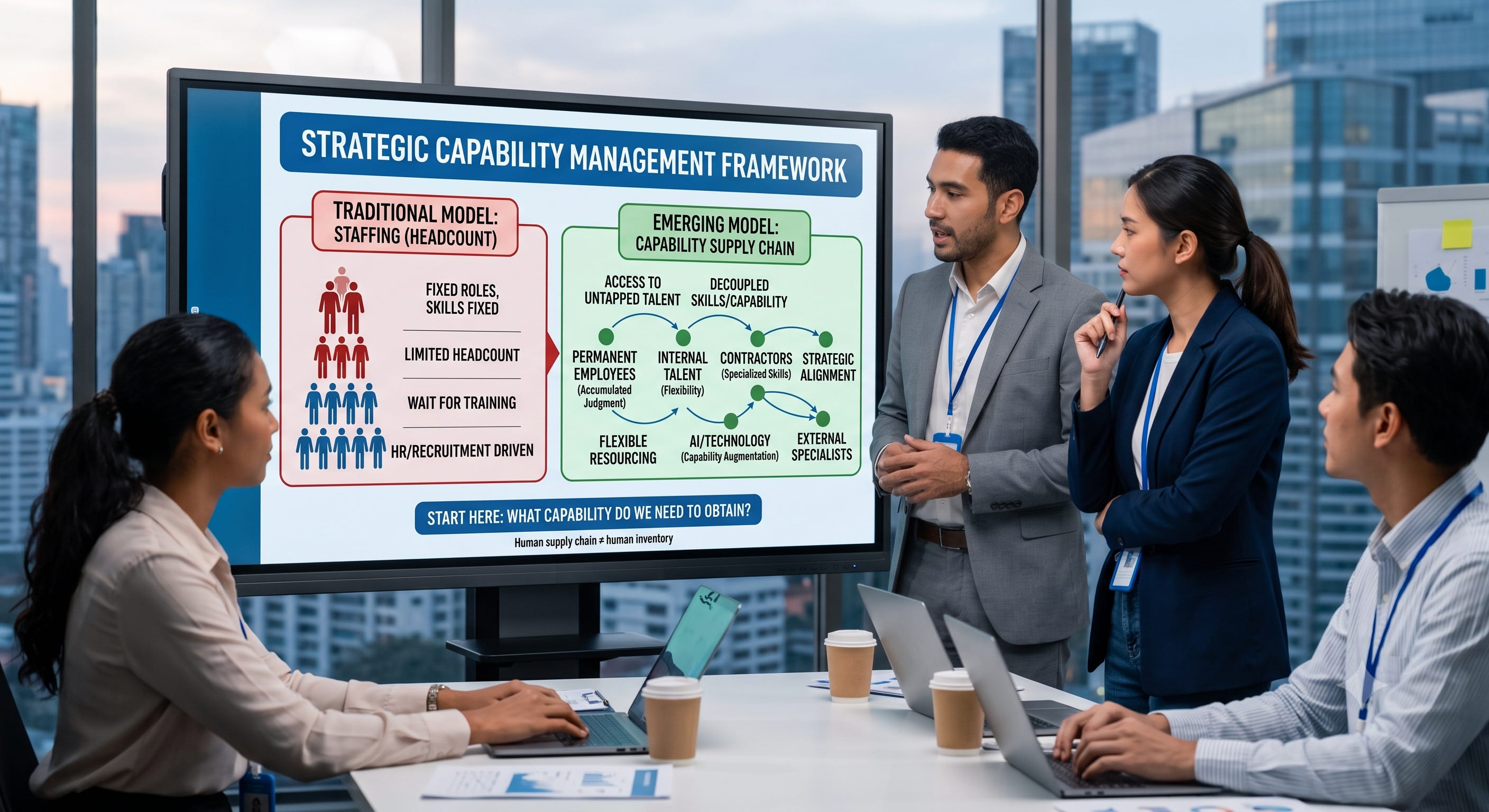
For most of the industrial era, workforce planning rested on an assumption: organizations hired people because those people possessed skills the organization needed. Employees developed those skills, accumulated experience and organizational knowledge, and became more valuable over time.
That assumption is becoming less reliable.
The World Economic Forum reported in 2025 that employers expect roughly 39 percent of workers’ existing core skills to change or become outdated by 2030. Whether the exact number proves correct is less important than what it tells us about employer expectations. Companies increasingly believe that skills are changing too quickly for occasional training and periodic hiring to keep pace.
For decades, when an organization needed more software capabilities, it hired more programmers. Coding ability was scarce, and the programmer was the container in which that capability resided. Artificial intelligence is beginning to loosen that relationship.
Research on AI-assisted software development suggests that AI can significantly increase developer productivity. At the same time, companies adopting these tools do not necessarily stop hiring engineers. Instead, the nature of engineering work changes. Greater value lies in defining problems, understanding the business context, choosing the architecture, evaluating AI-generated work, identifying failure modes, and exercising judgment.
The skill has not disappeared. The capability has been redistributed. That distinction may become one of the most important ideas in workforce strategy.
A skill belongs to an individual. Capability is the organization’s ability to get something done.
For much of the twentieth century, these were almost synonymous because the primary way organizations acquired capability was by hiring people with the necessary skills. If a company needed accountants, engineers, recruiters, lawyers, designers, or marketers, it put more of them on the payroll. The workforce became the warehouse in which organizational capability was stored.
That is beginning to change.
Recruiting Is Changing Too
Recruiting has been mediated by technology for decades. Applicant-tracking systems collect résumés, organize candidates, search for keywords and help recruiters manage enormous quantities of information. Increasingly sophisticated systems source candidates, match people to jobs, administer assessments, schedule interviews and recommend priorities. The critical issue is not whether machines are making every hiring decision. They are not.
The issue is that technology increasingly determines the information environment in which human decisions are made. A recruiter may never see every application. A hiring manager may encounter only candidates that an algorithm has already prioritized. The human may still make the final decision, but technology increasingly determines which decisions reach the human.
Generative AI has simultaneously transformed the candidate side of recruiting. Today virtually anyone can generate a polished résumé, tailor an application to a specific position, prepare answers to likely interview questions, research the organization and rehearse responses at almost no cost. There is nothing inherently wrong with this. Candidates have always sought help presenting themselves.
But when polished presentation becomes nearly universal, presentation becomes a weaker signal. A perfectly tailored résumé tells us less about the effort someone invested in understanding the position. A polished response to a predictable interview question tells us less about how the person thinks when facing an unfamiliar problem.
Consequently, evidence that is harder to manufacture becomes more valuable, such as demonstrated performance, work samples, reputation, validated skills, references, professional relationships, and direct interaction.
As the cost of producing information falls, the value of interpreting information rises.
This is why I believe the future belongs partly to what I have written about previously, and I called the artisan recruiter. The artisan recruiter is not anti-technology. Quite the opposite. AI should handle research, sourcing, scheduling, administration, and analysis wherever it can do these things effectively. What the recruiter should not give up is her judgment.
Stop Asking Whom to Hire
The larger transformation goes beyond recruiting.
The traditional workforce model asks:
