What Is Being Human?
Some Ruminations on Tomorrow and AI
Most of the conversation about AI runs on industrial age assumptions. We talk about jobs. Productivity. Labor. Efficiency. Augmentation. All of it is surface stuff and first-order effects. The deeper question is what is left that is distinctly human when intelligence and knowledge stop being scarce?
We have always defined ourselves partly through consciousness and language. We were the planners. The pattern spotters. The strategists. The ones who reasoned in symbols. That was why we thought we were special.
AI is rewriting that story. Not perfectly, not quite yet, but the direction is set, and it does not reverse.
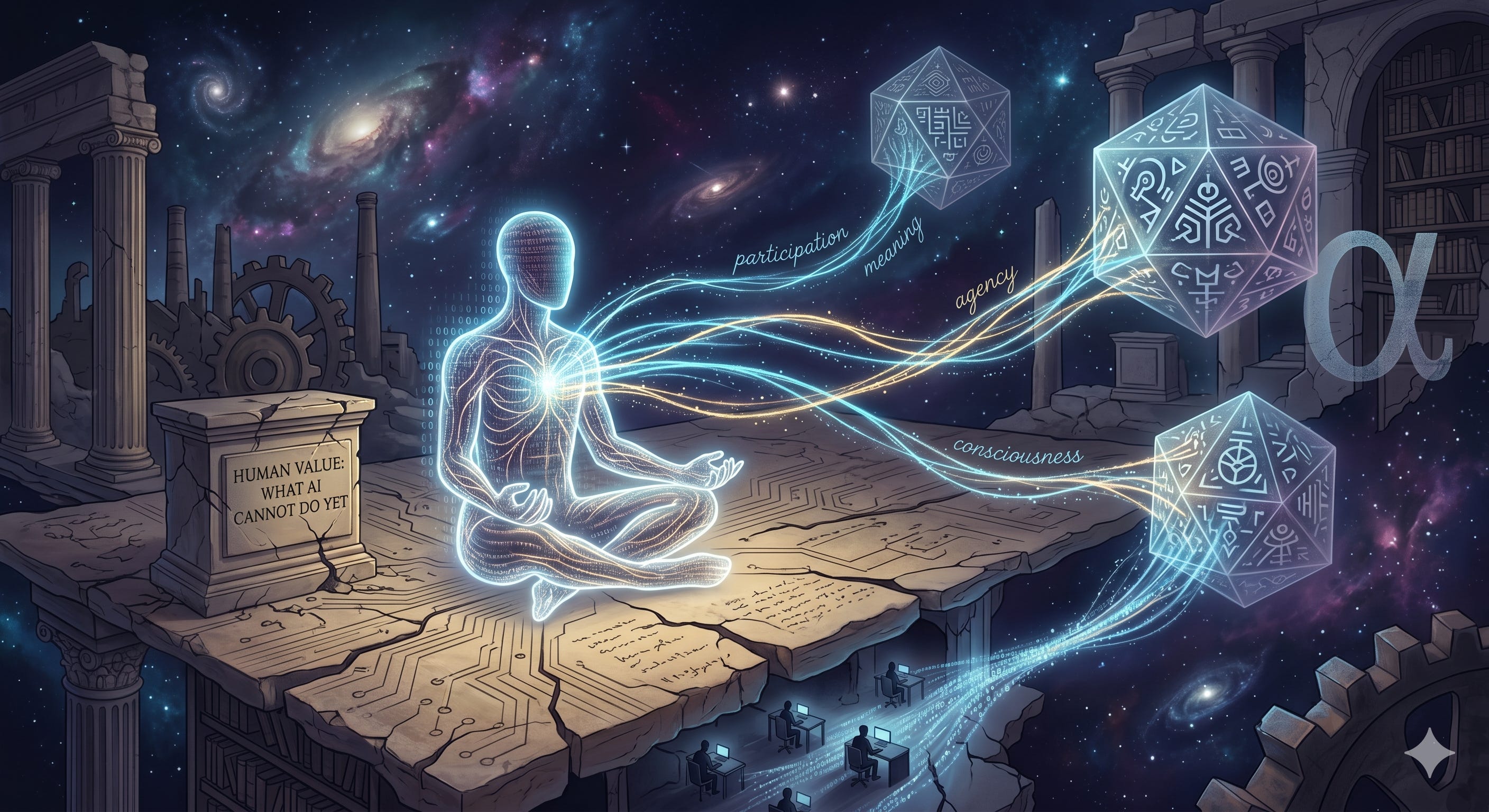
We assume human value is whatever AI cannot do yet. But that notion is a slippery slope. First goes Chess. Then translation. Coding. Research. Medical diagnosis. Every one of those was once proof of human uniqueness. One by one, they fell.
So the future is not about protecting human exclusivity. It is about rewriting what we mean by participation, meaning, agency, and consciousness itself. That is a far bigger thing than a shaken-up job market.
The deep questions can wait. The next ten years are going to hurt long before anyone gets philosophical about it.
This wave is different from the ones we keep comparing it to. Factory automation and farm mechanization came for physical work first and gave people decades to climb into offices. This time it lands on the office. Drafting, summarizing, first pass analysis, code, research, document review, and routine customer contact. That is the work that pays the mortgages of the educated middle class today, and it is exactly the work that gets cheap and automated first.
Nobody fires the whole department on a Monday. That is not how it goes. As we can already see, companies stop backfilling roles that are left. They slow down graduate hiring. They quietly expect the team of eight to do what the team of twelve used to do. In some cases, it is mass layoffs of lower-level workers; in other cases, it shows up as a hiring freeze rather than a layoff, which is why it is easy to miss until you are the one not getting hired.
The first rung that breaks is the bottom one. Entry-level white-collar work is what AI now does at a fraction of the cost. That creates a problem nobody has solved. If the machine does the junior work, where do the seniors come from? You cannot develop experienced judgment without the years of grunt work that built it. We are about to find out what happens to a profession that eats its own pipeline.
For anyone in talent acquisition, the change is direct. The job stops being about filling requisitions faster and starts being about deciding what the workforce should even look like. Fewer reqs. More questions about which work needs a human at all, which gets handed to a system, and how you keep an organization learning when the apprenticeship layer is thinning out.
Call it the efficiency purge. Not a collapse, but a steady reweighting of who and what an organization is willing to pay for. It runs unevenly, faster in some sectors and places than others, across five to fifteen years rather than five to fifteen months. The mistake is treating it as a temporary disruption you ride out. It is a structural reset.
That is the near term. It is real, it is already moving, and it is still only the first-order effect.
AI is not a tool
We still talk as if there are two separate players at work. Human plus machine. Worker plus tool. But a powerful enough AI does not act like a tool in any sense we know. There may not be a partnership between human and machine. Or whatever partnership there is may be temporary.
AI will likely become a layer, an extension of memory and perception. A system that evolves alongside us and shapes how we think. That changes humans as much as it changes work.
We can already see the rough early versions of this change. People offload memory to their devices. They outsource judgment to recommendation engines. They let AI write and think for them. They hand emotional contact to algorithms. They build part of their identity inside digital systems.
Future AI looks less like software and more like the infrastructure for thinking. Infrastructure is the stuff you build on top of without noticing. You do not “use” it as a separate act. It just underwrites everything else you do. When it works, it is invisible. When it breaks, everything sitting on it stops.
In the future, you would no more think that someone “used AI to write an essay” than you would think someone “used the alphabet to write an essay.” AI is a substrate, not an app.
What survives
So, what part of being human survives when intelligence is everywhere and free?
Start with the body. We live inside physical reality through sensation, mortality, pain, aging, desire, and plain biological limits. AI can model all of that. It does not live it.
Then there is consciousness. We still cannot explain why subjective experience exists at all. Intelligence and consciousness may be two different things. AI could blow past us intellectually and still have nothing going on inside. Or it could grow something conscious that is nothing like ours.
It may also become or act as an alien. People keep imagining AI growing up to be like us. More likely, it develops nonhuman forms of reasoning and perception. No emotion. Massively parallel. Running on a different clock. Not located anywhere in particular. Indifferent to survival or status. At home in concept spaces that we cannot picture. That makes it less like a person and more like a separate category of mind.
Most people still think about AI in terms of its effects on the economy and work. The bigger story is that it is closer to a new civilization.
If intelligence becomes infinite, cheap, everywhere, and always on, then every institution built on scarce expertise wobbles. The industrial world was organized around scarce labor. The knowledge economy is organized around scarce expertise. AI removes or reduces the value of both. It removes the need for management, professional status, credentials, corporate hierarchy, government administration, and even the whole idea of a career identity.
In every past technological revolution, we survived by climbing. Physical labor to cognitive labor. But AI climbs the entire cognitive ladder with us, and then past us. The human job shifts toward interpretation, ethical judgment, experience, relationships, and deciding what the goals should even be. Less doing the task. More deciding which tasks are worth doing and why.
The hard part is psychological. We get our identity from being useful. If AI eventually takes away most of the things the market pays for, the crisis is not economic. It is existential. What is a human life for if not productivity?
That is the question that will define the rest of this century. If survival no longer depends on labor, we either rediscover what industrial life trivialized or we drift into passivity and dependence on the algorithm.
The deciding factor is probably not how capable AI gets. It is whether we keep our hands on the wheel while the systems around it take shape. These shifts move unevenly and across generations. We are at the start of a long transition, not anywhere near the end.
So the important question was never “which jobs survive AI?” It is this. What stays uniquely meaningful about being human once we share the world with a mind that is not human at all?
I take on a few advisory clients a year. Mostly, firms want someone to tell them the truth about the talent market rather than what they hope to hear. If that is useful to you, email me DM me..


