

Many TA leaders measure their importance and power by the size of their team. More headcount means more budget, more influence, more organizational power. A thirty-person recruiting department needs a director, but a five-person team only needs a manager. In a traditional corporation, this makes a difference.
But in the emerging new world, a large team is a death sentence.
The large, in-house recruiting department is dying. And the leaders who create a new model, one borrowed from operations, are the ones who thrive.
The model that replaced manufacturing should replace recruiting
In the 1970s, most large manufacturers owned the entire production process. They made the parts, assembled the product, and ran the warehouses. Vertical integration was normal. Then lean operations theory, followed by global supply chains, turned that logic inside out. By the 1990s, the most efficient manufacturers had learned to own the design and the relationships, not the manufacturing or the labor. Semiconductors are designed in the US and built in Taiwan; Nike does not make shoes. Apple does not build iPhones.
But the TA and HR functions are still operating under the manufacturing model, where they own everything. They staff for peak demand and measure activity as if that showed their effectiveness.
The result is a function that has too many recruiters when hiring is slow and not enough when hiring demand peaks.
What the new model might look like
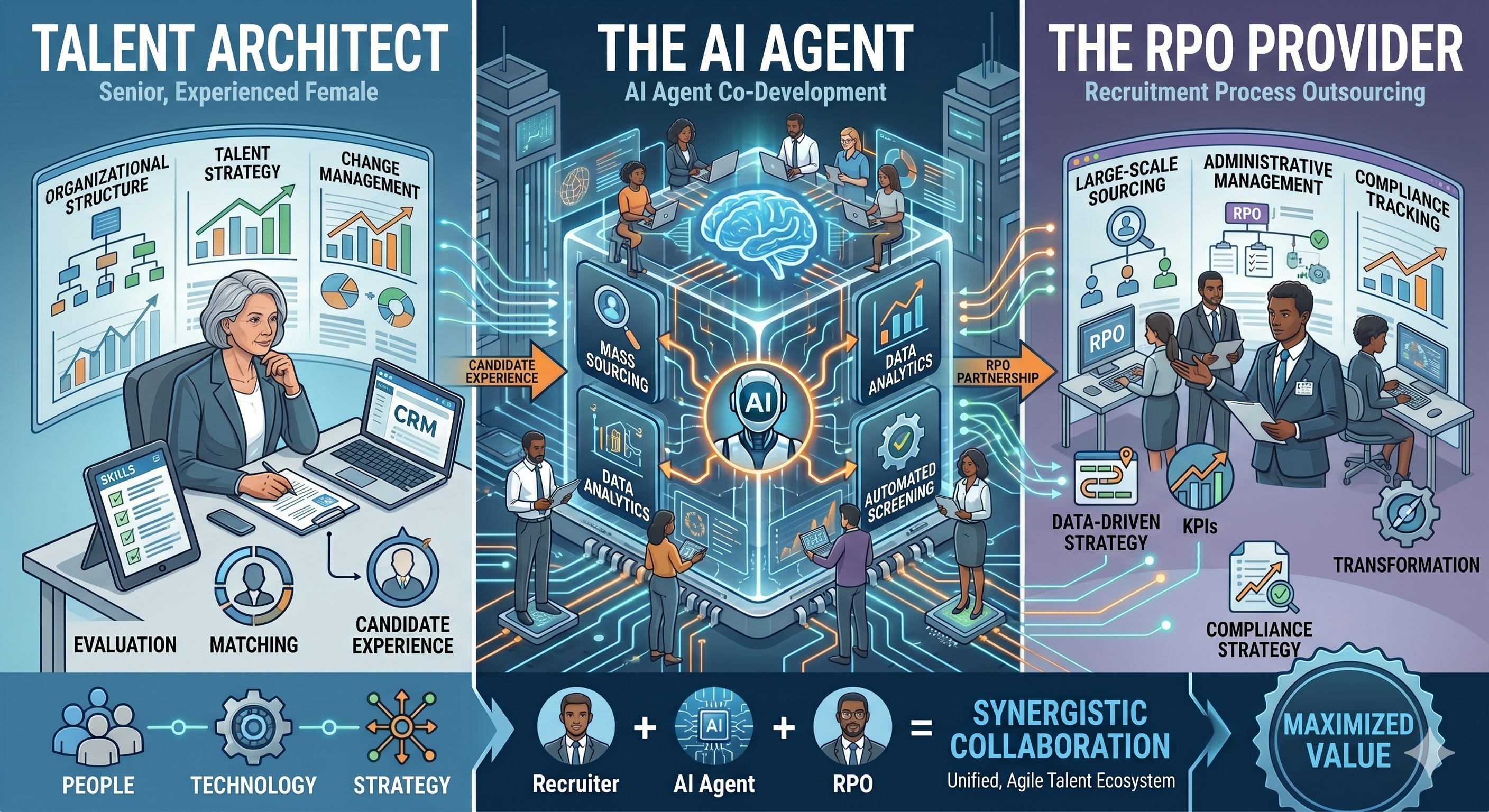
The future is about developing and nurturing a small, senior team. I call them Talent Architects. Their job is not to recruit. Their job is to design, source, orchestrate, and measure a recruiting supply chain that does the recruiting for them.
That supply chain has three main components.
The first is specialized external recruiters engaged on an as-needed basis. A network of specialists, technical sourcers, executive search practitioners, and diversity-focused boutiques, each used for specific roles and time-defined engagements. You pay for output. You pay for fills. You do not pay for availability.
The second is RPO capacity that scales with volume. The right RPO relationship is not a blanket outsourcing arrangement. It is a defined engagement covering specific job families, geographies, or hiring cycles. When volume drops, the engagement scales down. There are no conversations about carrying costs.
The third, and the one most TA leaders have not yet taken seriously, are AI agents. Not AI-assisted recruiters. AI agents operating as first-line sourcers, screeners, and scheduling coordinators. More top-performing teams are leveraging these agents to handle high-volume screening workflows without human intervention. The next generation of agents will take over passive sourcing and initial outreach. They will be able to screen candidates and provide them with feedback. These agents are not tools for recruiters. They are recruiters. They just do not have paychecks.
The Talent Architect sits above all three. They design the intake process. They set the quality bar. They manage the vendor relationships and the AI configurations. They own the data. They are accountable for outcomes.
The metrics have to change
A supply chain model requires supply chain metrics. And supply chain metrics have a clear boundary. Recruiting owns the process, but the business owns the employment relationship. The moment a hire walks in the door, the recruiting supply chain’s job is done.
This is not a dodge. Holding recruiting accountable for retention, performance, or engagement is like holding a manufacturer responsible for how the buyer uses the product. The variables after handoff are no longer yours.
